


News
IGTP researchers take part in the 8th edition of #científiques bringing science closer to schools
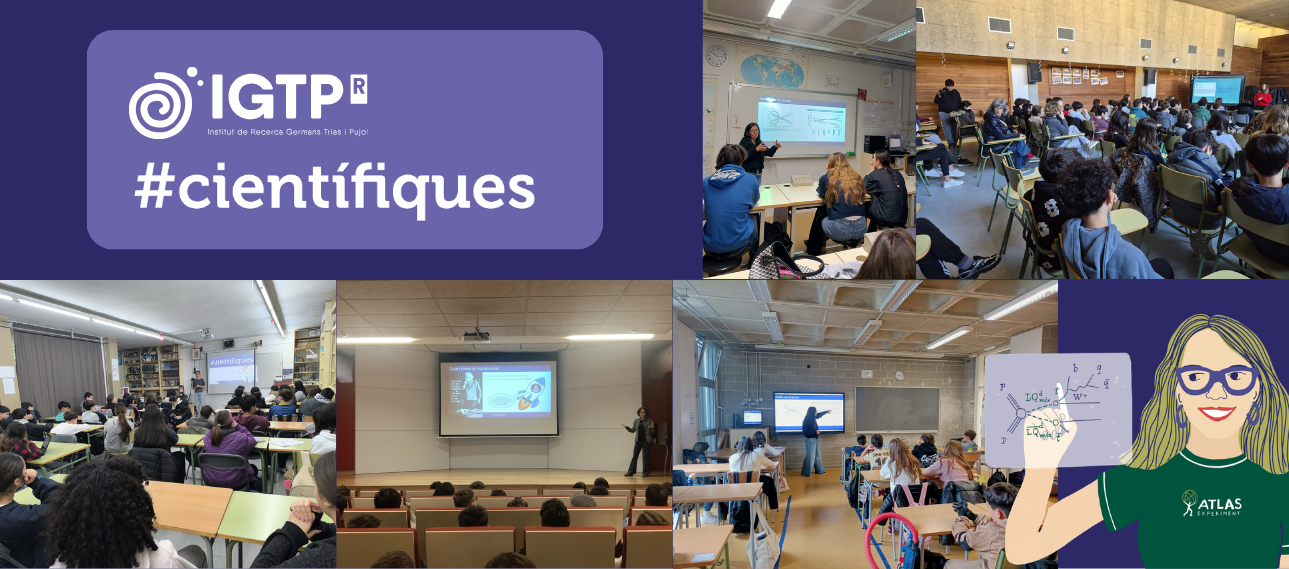
For the fourth consecutive year, researchers from the Germans Trias i Pujol Research Institute (IGTP) are taking part in the #científiques initiative, bringing science closer to schools and creating female role models in the framework of the International Day of Women and Girls in Science (11 February).
This initiative, organised by the Fundació Catalana per a la Recerca i la Innovació (FCRI) and the Barcelona Institute of Science and Technology (BIST), in collaboration with the Departments of Education and of Research and Universities of the Government of Catalonia, has established itself as a reference project to promote scientific-technical vocations among boys and girls, contributing to combat gender stereotypes in the scientific field.
The main objective is to highlight the contribution of women in science and technology, as well as to create real and relatable role models of women in STEM disciplines (Science, Technology, Engineering and Mathematics) that can inspire students and awaken interest in these fields of knowledge. In this 8th edition, about 600 scientists from public and private research entities around Catalonia have offered talks to about 40,000 students from 6th grade and 1st ESO in 530 educational centres throughout the territory. These talks, the result of a process of collaboration and joint work between researchers and schools, address the life, career path and professional work of each of the #científiques.
What drives them to take part?
This year 12 researchers from the IGTP have participated, delivering both in-person and online talks across the region throughout February. They themselves explain what inspires them to be involved:
- Anna Martínez (El Pilar, Premià de Mar): To encourage young future scientists to look beyond social media. To bring science into focus for our young people, because they are our future as scientists.
- Arola Fortian (Escola Sant Jordi Desvalls, Girona): Científiques is a wonderful interactive initiative that allows us to bring science into schools and make the role of women in STEM careers more tangible, while listening to the concerns and curiosities of the younger generations.
- Gemma Monté (Institut Joaquima Vedruna, Terrassa): For me, taking part in the #Científiques program aims to spark curiosity and to show younger generations that engaging in high-level scientific research and contributing to society is within their reach. It is also a way of highlighting the diversity of profiles that make up the research community, with unique abilities that can become real strengths. We all have "superpowers" that we should nurture. Diversity enriches science, and sharing this message helps to create positive role models.
- Marta San Roque (Col·legi Sant Ferran, Barcelona): I take part in this initiative because I believe it is important that children, who are shaping their personalities and strengthening their values, understand that all ideas are valid and that anyone can pursue a career in science if that is what they truly want, whether they are boys or girls. I think it is important for them to keep this in mind, and that if at any point a girl considers holding back her opinion or not expressing an idea for fear of being dismissed, she knows that her contribution is just as valuable as that of any boy.
- Mariona Cortacans (Institut Euclides, Pineda de Mar): Participating in the 100tífiques program is an enriching experience for me every year: it allows me to share my work with students and, at the same time, leave feeling refreshed and inspired by their curiosity. Initiatives like this reinforce our commitment to science outreach and promoting scientific vocations, and boost the visibility of female role models in STEM.
- Mireia Jordà (Institut Pere Ribot, Vilassar de Mar): I have decided to take part in this initiative because I believe it is important to bring science closer to young people, so they can see our day-to-day work and, above all, be offered relatable role models. In particular, I think it is important for girls to see women working in science, to encourage them to consider this path. I also believe it is necessary to break the myths that often surround science, and doing so at this age is crucial: so they can see that the people who work in science are normal, diverse, and that if you have curiosity and motivation, you can pursue it, regardless of gender.
- Mònica Cabrera (Institut Vilatzara, Vilassar de Mar): I join to highlight the role of women in computational research and to inspire future scientists in bioinformatics.
- Mònica Suelves (Escola Port Rodó, Tarragona): It is always very rewarding to share my experience and motivation for research with primary school students. It is a pleasure to be surrounded by children who are curious about the world and to be aware of the questions they ask and the challenges they face. As every year, it has been a very enjoyable activity that I love taking part in.
- Nadia Llavero (INS Caldes de Malavella, Girona):
Science has no gender, it needs different perspectives, and it improves people's lives -everyone can contribute! - Susanna Jiménez (Escola Antoni Gaudí, Baix Llobregat): Scientific knowledge must be open, shared, and accessible to everyone. What cannot be seen cannot be imagined: female role models open doors and create possibilities.


Manuela Barranco will also take part in this edition at the Escola Sant Jordi Desvalls (Girona), during the month of March.
Building a network among Catalan women researchers
#científiques goes beyond the classroom. As every year, all participants gathered for a kick-off event held on 28 January at the Casa Convalescència (UAB Campus, Barcelona). The day focused on the visibility of women scientists in the media, addressing the challenges researchers face when communicating their work and providing expert opinions to the press. It was a meeting for reflection and dialogue, sharing perspectives on science and its media presence.
This eighth edition has once again highlighted the importance of initiatives like #científiques, which promote new female role models and bring science closer to future generations through close coordination between schools and researchers. It represents a crucial approach to the early stages of education, showing that science is for everyone, with the aim of moving towards a more diverse, inclusive research free from gender gaps.
IGTP is committed to promoting equality and diversity, and works to ensure a work environment free from discrimination, harassment, and intimidation. In line with this commitment, we have developed an Equality Plan that includes a series of measures to ensure equal opportunities and prevent any form of discrimination. With the implementation of these measures and policies, the organisation aims to create an inclusive and respectful work environment that values and supports all its members.