


News
Experts in biomedical research, bioengineering and industry discuss alternative models to animal experimentation
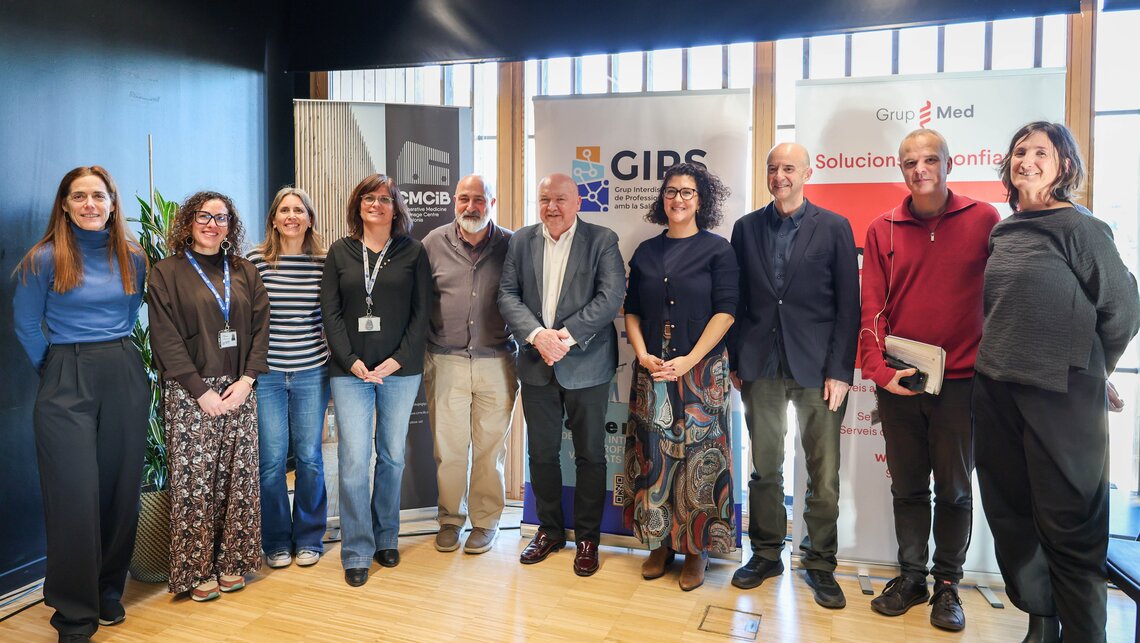
The Centre for Comparative Medicine and Bioimaging (CMCiB) of the Germans Trias i Pujol Research Institute (IGTP) co-organised a Cafè GIPS this Wednesday focusing on the challenges and opportunities posed by alternative models to animal experimentation in biomedical research. The session brought together professionals from research, bioengineering, innovation and industry with the aim of sharing experiences and perspectives on new approaches aligned with the 3Rs framework (replace, reduce and refine).
The event forms part of the activities of the Interdisciplinary Group of Health-Related Professionals (GIPS), a discussion forum promoted by the Council of Medical Colleges of Catalonia to foster collaboration across disciplines in the health field, as well as reflecting the commitment of the CMCiB and the IGTP to responsible, innovative and translational research.
The event opened with an institutional welcome by the IGTP Director, Jordi Barretina; Clara Prats, Chair of the Board of the GIPS Association; and Pere Toran, President of the Maresme Regional Board of the Barcelona Medical Association, with the participation of Teresa Sanchis, Director General for Research at the Ministry of Research and Universities. The speakers highlighted the importance of interdisciplinary research and the strategic relevance of this field for the Catalan research system.

The programme included a roundtable discussion bringing together complementary perspectives from the research and innovation ecosystem. From an industry and technology transfer standpoint, Domingo Gargallo, Director of Funditec Health and co-founder of ABAC Therapeutics, addressed the role of alternative models in the development of new therapies. In this context, he noted that "animals are individuals and should be regarded as patients", and emphasised the need to "develop predictive models" to move towards more efficient and ethical research.
From the perspective of applied biomedical research, Pere-Joan Cardona, Head of the Clinical and Experimental Microbiology Research Group at the IGTP and Head of the Microbiology Department at Hospital Universitari Germans Trias i Pujol, contributed a translational view from the laboratory to clinical practice, highlighting his research on latent tuberculosis infection using in vitro experimental models and the role of drosophila.
The bioengineering perspective was provided by Zaida Álvarez, Head of the Neural Regeneration Biomaterials Group at the Institute for Bioengineering of Catalonia (IBEC), who explained that "we aim to rationally design biomaterials that can be implemented in the nervous system. Animal models have contributed greatly, but we need to move towards more human-relevant models".
In turn, Eduard Serra, Head of the Hereditary Cancer Group and Co-Director of the Translational Cancer Research Program (CARE) at the IGTP, stressed the impact of these models on oncology research and the personalisation of therapeutic strategies, noting that "we want to connect research with the patient, and to do so we need to know how to build teams, because it is highly complex".
The session was moderated by Sara Capdevila, Technical Director of the CMCiB, and concluded with closing remarks by Georgina Vidal-Gavilan, Head of Innovation and Quality at Biorem, member of the GIPS Board and coordinator of the Cafès GIPS, who highlighted that "the Cafès GIPS are a meeting point for professionals to collectively address the challenges facing the health system".
The event concluded with a virtual visit to the CMCiB, allowing participants to learn about the centre, its activities and its role as a strategic infrastructure.

Through initiatives such as this, the CMCiB -a strategic project of the IGTP- strengthens its position as a key infrastructure in the development and implementation of alternative models that contribute to more efficient, translational and ethically and sustainably aligned biomedical research.